Ottoman and Persian Arms in the Imperial Armoury, Gifts and Booty From the East
Later on the route through the Imperial Armoury, the steel knights give way to blue cases full of curved sabres, pointed helmets, gilded pistols and jewelled harness. This is the section the museum calls Europe and Western Asia, and it's a reminder that for three centuries the Habsburgs' great neighbour, rival and enemy was the Ottoman Empire.
The objects came to Vienna in two ways: as diplomatic gifts, and as spoils of war.
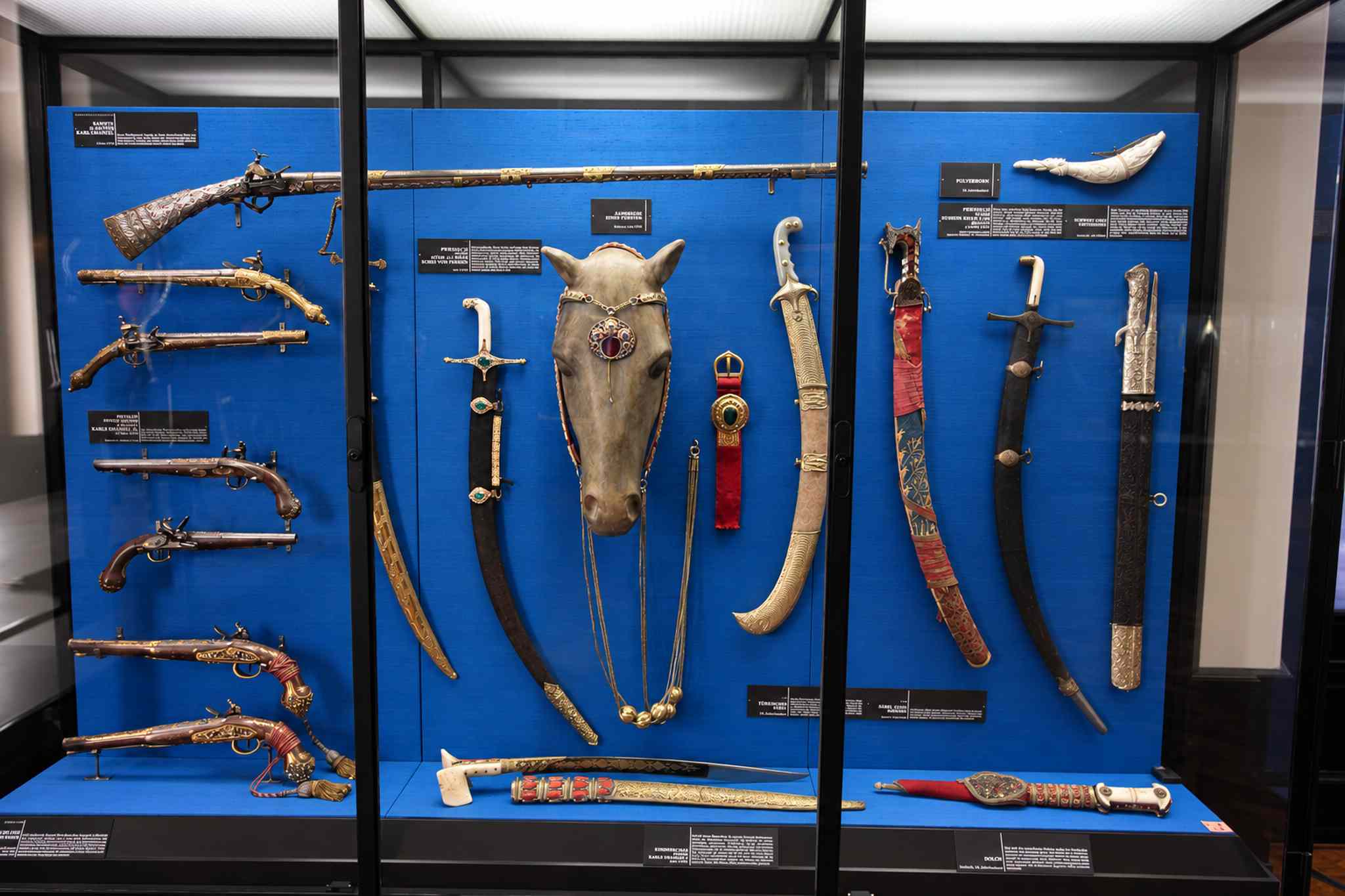
Photo: Virtual Travel Guide
Gifts between enemies
War and diplomacy ran side by side. Embassies went back and forth between Vienna and Constantinople, and both sides gave presents. The sultan gave bows as honorific gifts to European envoys, and the Armoury still has the fine bow cases and quivers of the 16th century that went with them.
Persian work is here too. One sabre in the collection carries a blade inscription naming Fath-Ali Shah of Persia, dated 1813, though the museum says it doesn't know how it reached Vienna. A curved dagger of about 1500, of the kind worn on the chest by the sultan's top officials, is so finely made that the museum thinks a Persian craftsman made it.
The saddle that wasn't Kara Mustafa's
The most famous story in this part of the museum turned out to be wrong. In the 19th century a red velvet saddle, embroidered in silver and gold, was said to have belonged to Kara Mustafa, the grand vizier who besieged Vienna in 1683, and to have been laid before the emperor after the siege was broken.
The museum found no archival evidence for any of that. The owner's mark on the saddle is the monogram of Sultan Mustafa II, who reigned from 1695 to 1703, and his campaign of 1697 ended in a crushing defeat by Prince Eugene at Zenta. So the saddle may well be booty, just from a different battle.
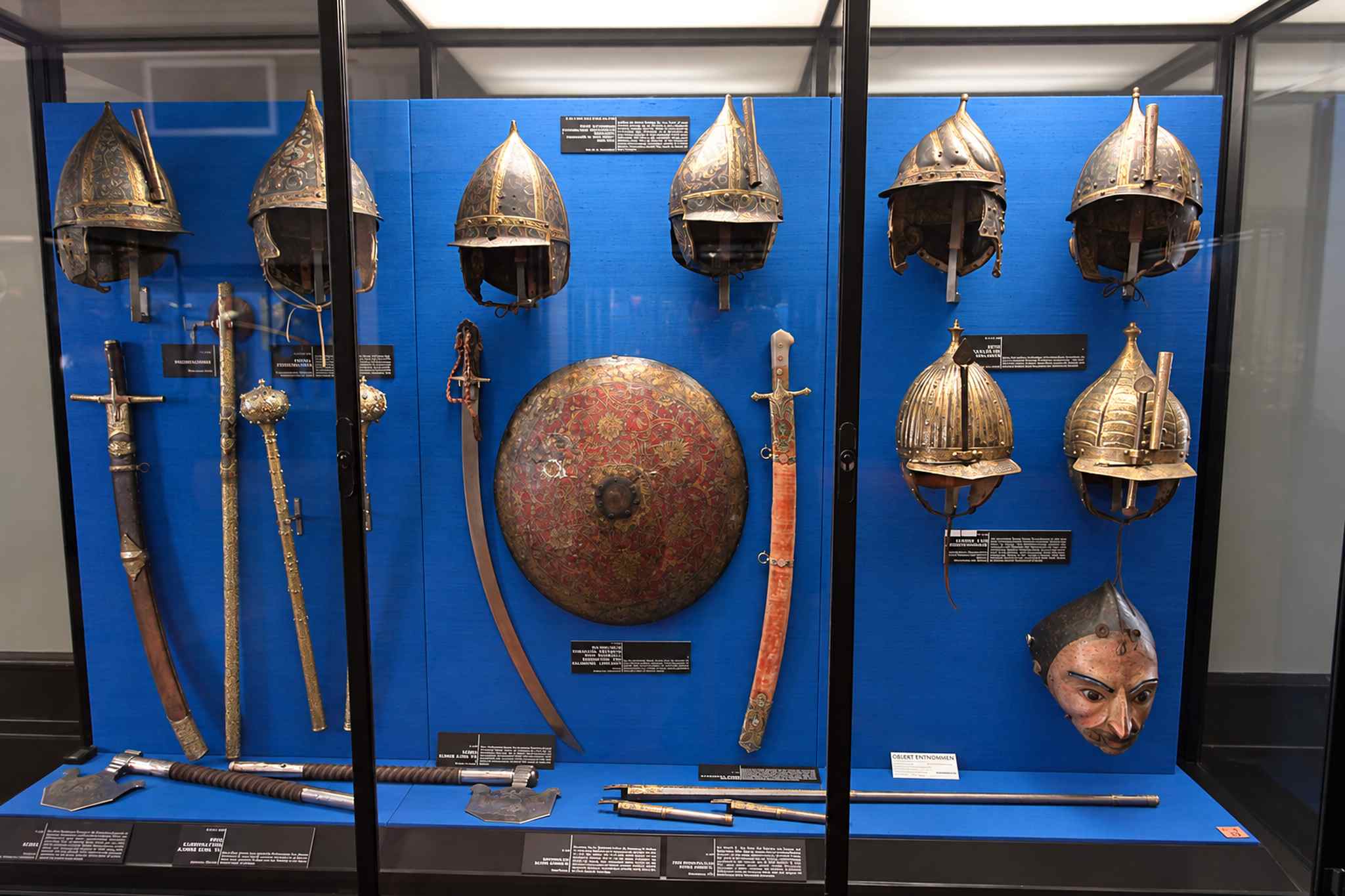
Photo: Virtual Travel Guide
The King of Cuba in India
Some of these pieces were collected long before Vienna's great sieges. Archduke Ferdinand II of Tyrol, who built the armoury of heroes at Ambras, owned an Ottoman general's armour with its shield, from the second quarter of the 16th century. His inventory of 1593 calls it the armour of "the King of Cuba in India". The museum thinks "Cuba" may mean Cambay in Gujarat, and that the armour reached Europe along Portuguese trade routes.
The round discs on its breast and back are a motif the museum traces back to Iran, perhaps as sun symbols, from where it spread to Central Asia and then to Europe.
What to look for
The cases are dense, and the labels are small. Look for the tall pointed helmets with cheek pieces and sliding nasal bars, the flanged maces, the round shields worked in gold, the sabres in velvet and metal scabbards, and the decorated flintlocks.
Seeing it
The section is in the Imperial Armoury in the Neue Burg, entered through the Weltmuseum. See our Armoury guide for the rooms, and our post on Skanderbeg's helmet and sword for the Albanian lord who fought the Ottomans for a generation. Prince Eugene, the victor of Zenta, stands in bronze outside on Heldenplatz.