Gothic Armour of Maximilian I in the Imperial Armoury, Lorenz Helmschmid and the Late Gothic Style
Late Gothic armour is the armour people picture when they think of a knight: slim, pointed, ridged like folded cloth, the steel following the line of a fashionable body rather than hiding it. One of the finest examples anywhere stands in the Imperial Armoury in Vienna, and for most of its life it carried the wrong name.
For centuries it was catalogued as the armour of Archduke Sigmund of Tyrol. The museum now attributes it to the young Maximilian I.
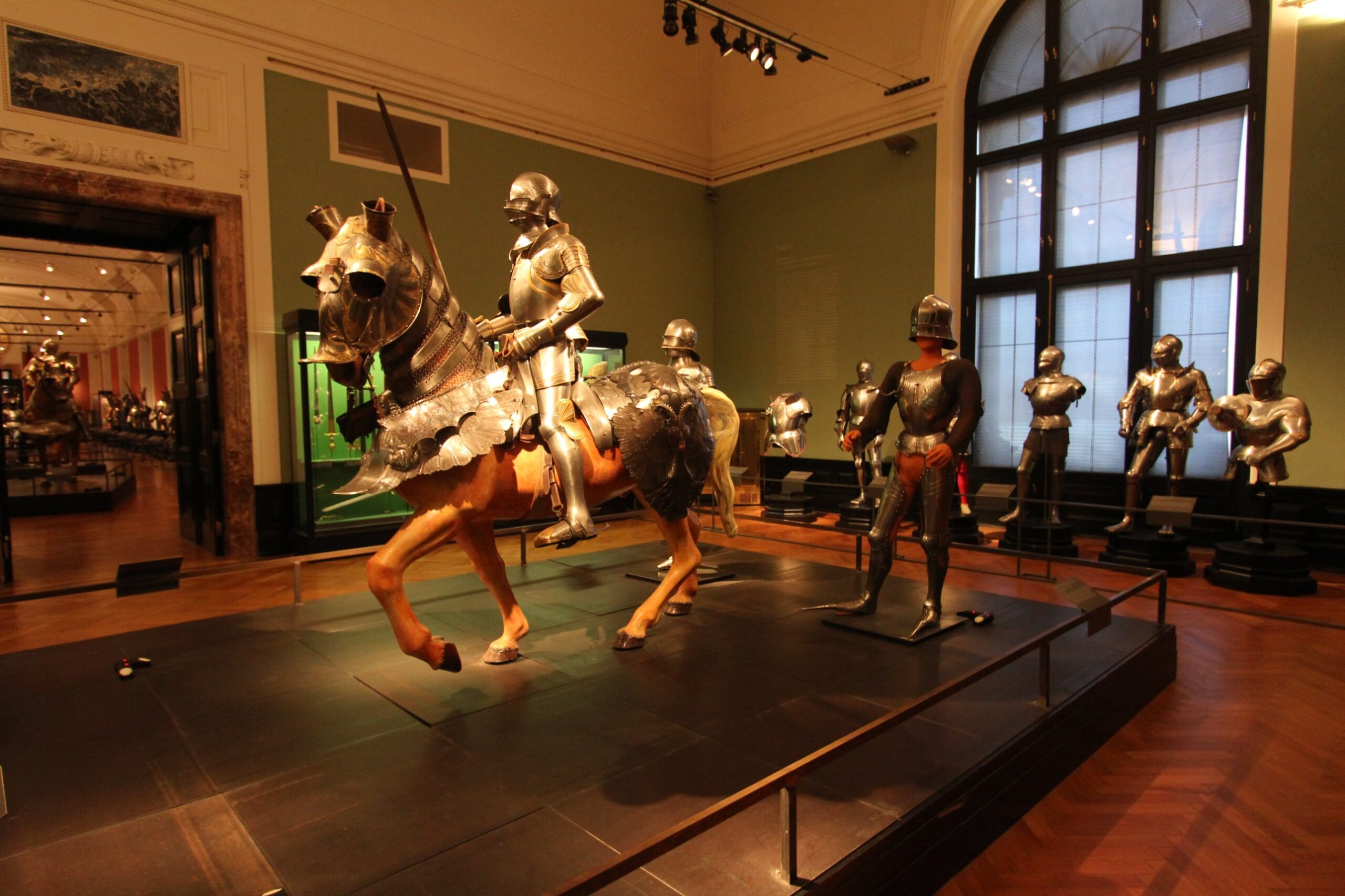
Photo: Virtual Travel Guide
The armour
It is a horseman's armour made by Lorenz Helmschmid of Augsburg around 1485. The sallet helmet carries his mark, a helmet with a cross as its crest, beside the pine cone of the Augsburg assay. The armour alone weighs 21.25 kilos, about what a full field armour of the time usually weighed, and stands 1.86 metres on its figure.
The museum calls it a high point of late Gothic German armour. Look for the radiating flutes, the gilt brass edging, the borders pierced in geometric and lily patterns, and the long pointed sabatons that copy the fashionable shoes of the day.
Sigmund or Maximilian
The old name came from Ambras. Archduke Ferdinand II kept it in his Heroes' Armoury there, and the illustrated catalogue of that collection, the Armamentarium Heroicum of 1601 to 1603, shows it as Sigmund's.
The museum's case for Maximilian is simple. When it was made, Sigmund was nearly 60 and there is no record of him ordering from Helmschmid. Maximilian was about 25, and he had been ordering from Helmschmid since about 1480. The slim, youthful figure fits the younger man.
Lorenz Helmschmid
Helmschmid was one of the great armourers of his age. He came from an Augsburg family of armourers, became a master in 1477, and that same year the city tax records mention costly armours he had made for the emperor, Frederick III. Maximilian brought him to Ghent in 1480 and kept him there for more than a year, and in 1491 made him court armourer. His son Kolman took over the workshop in 1515 and worked for the next generation of Habsburgs.
Frederick III's horse armour
Nearby is another Helmschmid piece: part of a heavy horse armour documented as made in 1477 for Maximilian's father, Emperor Frederick III. The horse's head defence and neck armour were added in Innsbruck in 1514, under Maximilian. It's iron, embossed, etched, blued, painted and pierced, with gilt brass and embossed leather.
Seeing it
The Gothic room is early in the Imperial Armoury's sequence, on the first floor of the Neue Burg. See our Armoury guide for the layout, and our post on tournament armour for the jousts Maximilian loved.