Radziwill Half Armour in the Imperial Armoury, the Painted Armour of the Black Radziwill
Most armour in Vienna is bright steel, sometimes blued, sometimes gilt. This one looks as if someone has painted a carpet on it. Every plate, from the open helmet to the gauntlets, is covered in strapwork in gold, red, black and white, a pattern of interlaced bands that runs over the breastplate, the shoulders and down the arms.
It was made around 1555 for one of the most powerful men in eastern Europe, and it came to Vienna through Archduke Ferdinand II of Tyrol, the great armour collector.
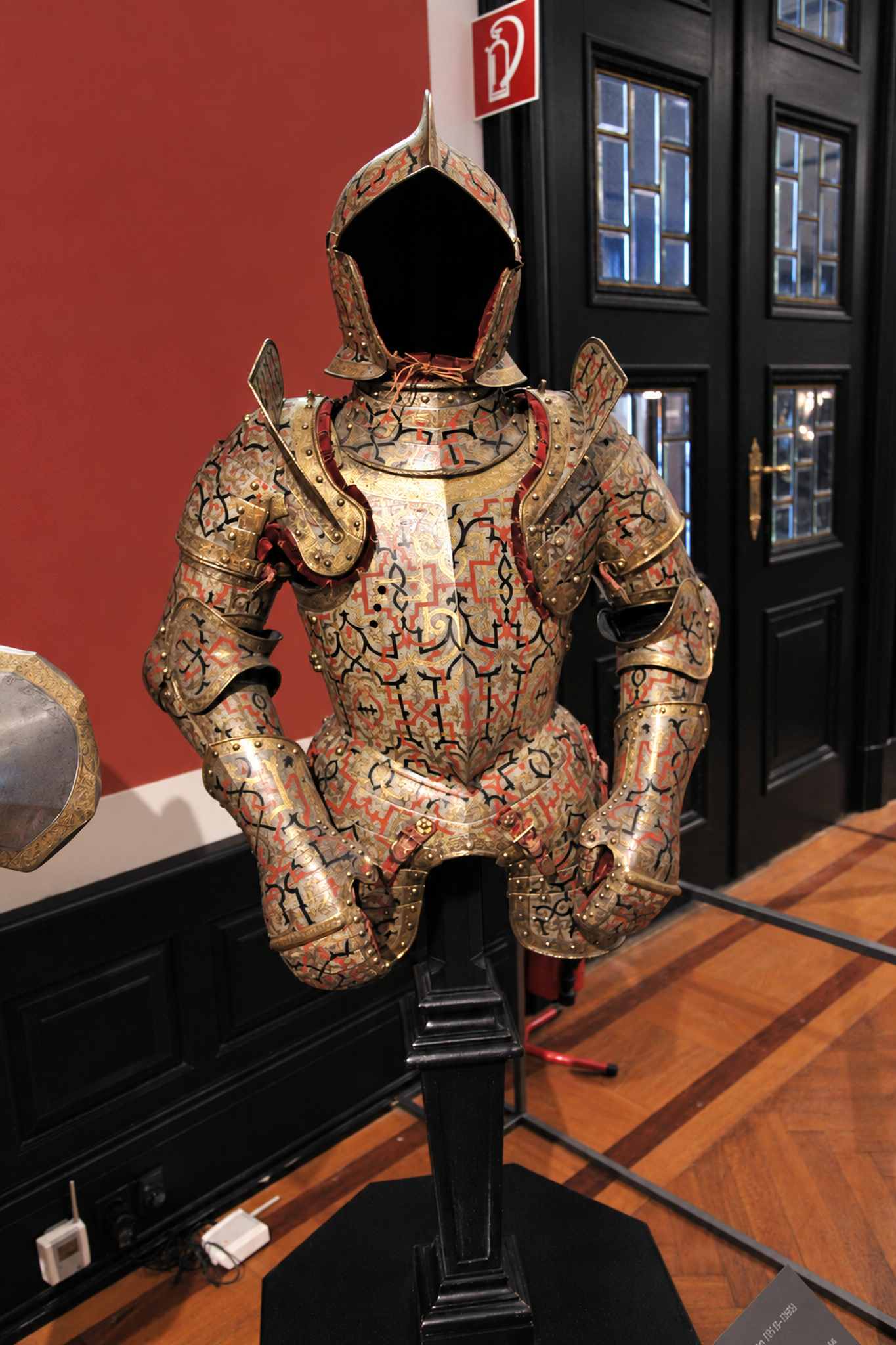
Photo: Virtual Travel Guide
The man it was made for
Mikołaj Radziwiłł, called the Black, lived from 1515 to 1565. He was the closest adviser of Sigismund II Augustus, King of Poland and Grand Duke of Lithuania, and the king made him Grand Hetman, Grand Chancellor and Voivode of Vilnius. In practice he ran the grand duchy. Emperor Charles V made him a prince of the Holy Roman Empire.
He was also a Protestant, and a serious one. He helped spread the Reformation in Lithuania and Poland and was instrumental in publishing the Brest Bible of 1563, the first Protestant translation of the Bible into Polish. His son went back to the Catholic Church.
How it was made
The museum attributes the armour to Kunz Lochner of Nuremberg, one of the leading armourers of the day. The iron was forged, embossed and etched all over. Parts of the etched pattern were fire-gilt, and some of the bands were painted red, white or black. The rivets, buckles and rosettes are gilt iron too, and remnants of the original red straps and lining survive.
That all-over colour is the surprise. The museum calls it unusual for German armour and thinks it reflects the taste of the man who ordered it. It's a half armour, protecting head, body and arms, 98.5 centimetres high on its own and just over 21 kilos.
It was once part of a bigger set, a garniture with extra pieces for battle and for the tournament. Other parts of it stayed in the Radziwiłł armoury at Nieśwież, the family seat, and are now in Paris and New York.
From Lithuania to the Tyrol
By 1593 the half armour was in Ferdinand II's collection. An inventory of his estate three years later describes it as a half armour etched on a white ground, with its burgonet, the open helmet you see on top. Ferdinand collected the armour of famous commanders of his time. His armour came to Vienna with the rest of the Ambras collection.
The museum keeps two more Radziwiłł pieces: an armour from around 1545, and parts of a half armour from the 1580s made for his son Mikołaj Krzysztof.
Seeing it
The half armour is in the Imperial Armoury in the Neue Burg, entered through the Weltmuseum. See our Armoury guide for the rooms, and our post on Ferdinand II's own armours for the man who collected it.