Mozart and the Hofburg From Court Music to the Burggarten Monument
Mozart stands in white marble in the Burggarten, one hand extended, with the Hofburg rising through the trees behind him. It is an easy place to connect Vienna's imperial history with its musical life. The connection goes deeper than the statue. Mozart worked for Emperor Joseph II, supplied music for dances inside the palace and saw major operas reach the stage at the old theatre beside it. The memorial gives those less visible connections a place to begin.
In the photograph, a pink treble clef curls across the green lawn, its flower heads bright against the soft grey of the path. Rows of dark green chairs follow the hedge along the left side and continue around the garden. Beyond them, pale columns and green-patinated rooftop figures emerge between thick trees, while the monument stands against foliage turning brown and gold. Small sculpted figures cluster around its pedestal, below Mozart's standing figure and the gold lettering on the front. The cloudy light leaves the marble gentle rather than glaring. There is room here to stop and look, which helps.
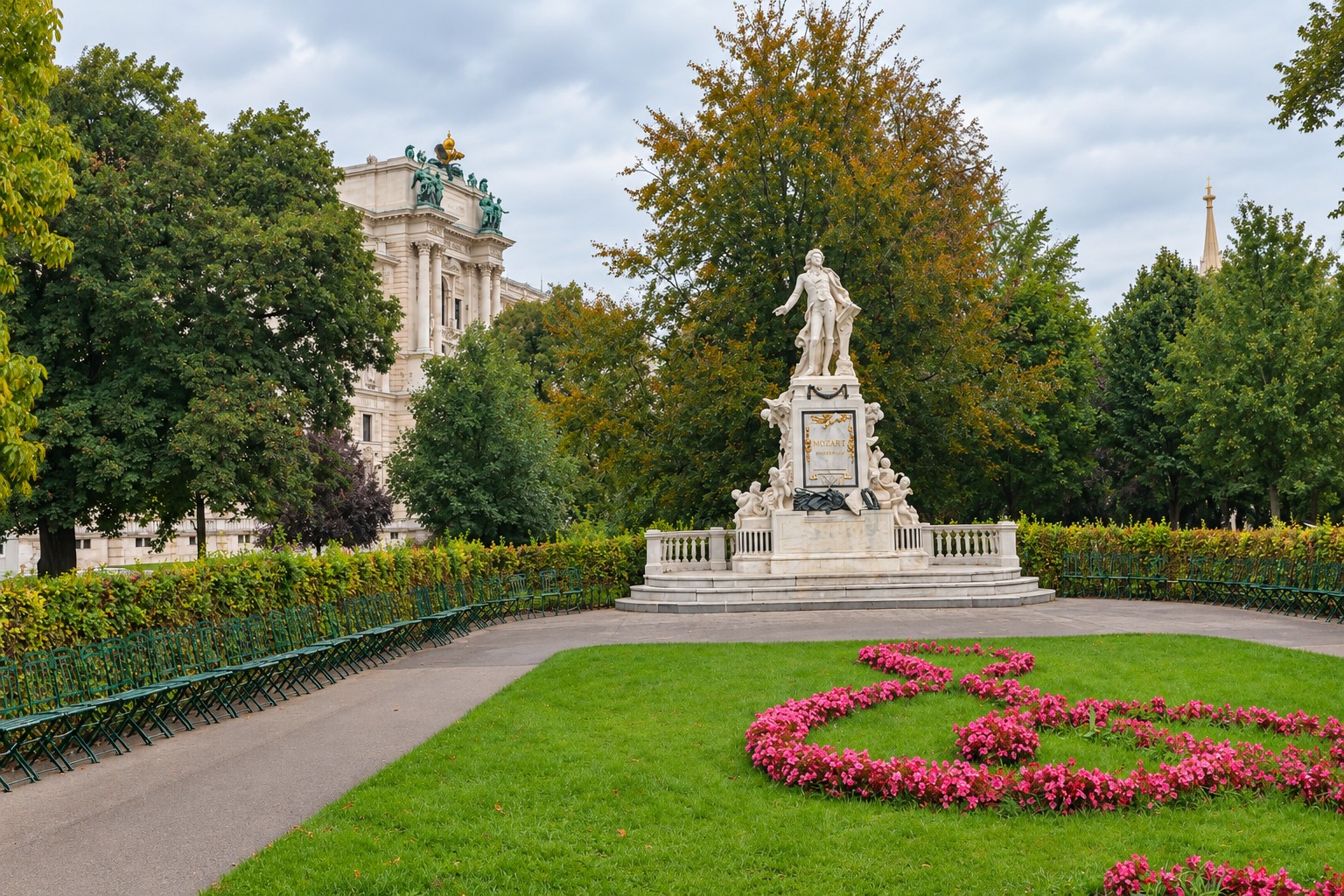
Photo: Travel Marketing
The monument belongs to a much later Vienna than Mozart knew. Viktor Tilgner's sculpture was unveiled on 21 April 1896 at the former Albrechtsplatz, today's Albertinaplatz. It moved to the Burggarten in 1953. The garden's present landscape also developed after the composer's death: it was redesigned for Emperor Franz I between 1817 and 1819, following the destruction of nearby fortifications during the Napoleonic Wars, and opened to the public in 1919. Mozart never walked through this scene as it appears today. Our guide to the Burggarten and Volksgarten follows that later transformation.
His working connection to the Hofburg is clearest in the Redoute Rooms, the palace spaces associated with masked festivities and dancing. In December 1787 Joseph II appointed him to a salaried court position. Mozart's duties included composing dance music for the imperial masked balls, for an annual salary of 800 gulden. For a composer also earning through teaching, performances and commissions, the appointment added dependable income. The work had a practical purpose: people needed music they could dance to. It puts a different sound into the palace's grand rooms, away from the solemnity that visitors may expect.
Joseph's patronage also helped shape Mozart's operatic career. The emperor supported German-language musical theatre, and The Abduction from the Seraglio premiered at the Burgtheater on 16 July 1782. Its mixture of sung music and spoken dialogue belonged to that theatrical world. Its success did not immediately bring Mozart the court appointment he wanted; that followed years later. Imperial approval could open doors, but building a livelihood still meant finding pupils, audiences and the next commission.
The Marriage of Figaro brought Mozart and librettist Lorenzo da Ponte to the same theatre on 1 May 1786. Its story of servants outwitting their master had an awkward relationship with the social hierarchy around the court. Joseph permitted the opera even though the underlying Beaumarchais play had faced restrictions. Così fan tutte followed there on 26 January 1790. These premieres belong to the old Burgtheater beside the Hofburg, rather than the present theatre on the Ringstrasse. Keeping that distinction in mind makes a walk around the palace easier to read.
Another useful stop is Joseph II's equestrian monument on Josefsplatz. The emperor commemorated there was a significant patron in Mozart's working life, with his own musical preferences and the authority to influence what reached the stage. From the quiet lawn in the Burggarten, it is possible to trace a route back toward that world of salaries, rehearsals and court decisions. The statue offers a serene Mozart. The history around the Hofburg restores some of the effort behind the music.