Imperial Treasury Vienna, the Crown of the Holy Roman Empire and the Holy Lance in the Schweizerhof
If you see one thing in the Hofburg, make it the Treasury. It's small, about twenty rooms, and it holds the objects that made a Habsburg an emperor: two imperial crowns, the orb and sceptre, the coronation robes, and relics the dynasty treated as proof that God was on its side.
It sits in the Schweizerhof, the oldest courtyard of the palace, through the red and black Swiss Gate of 1552. The Kunsthistorisches Museum runs it. The current display dates from a refurbishment in the 1980s, and since 2012 it has been called the Kaiserliche Schatzkammer, the Imperial Treasury.
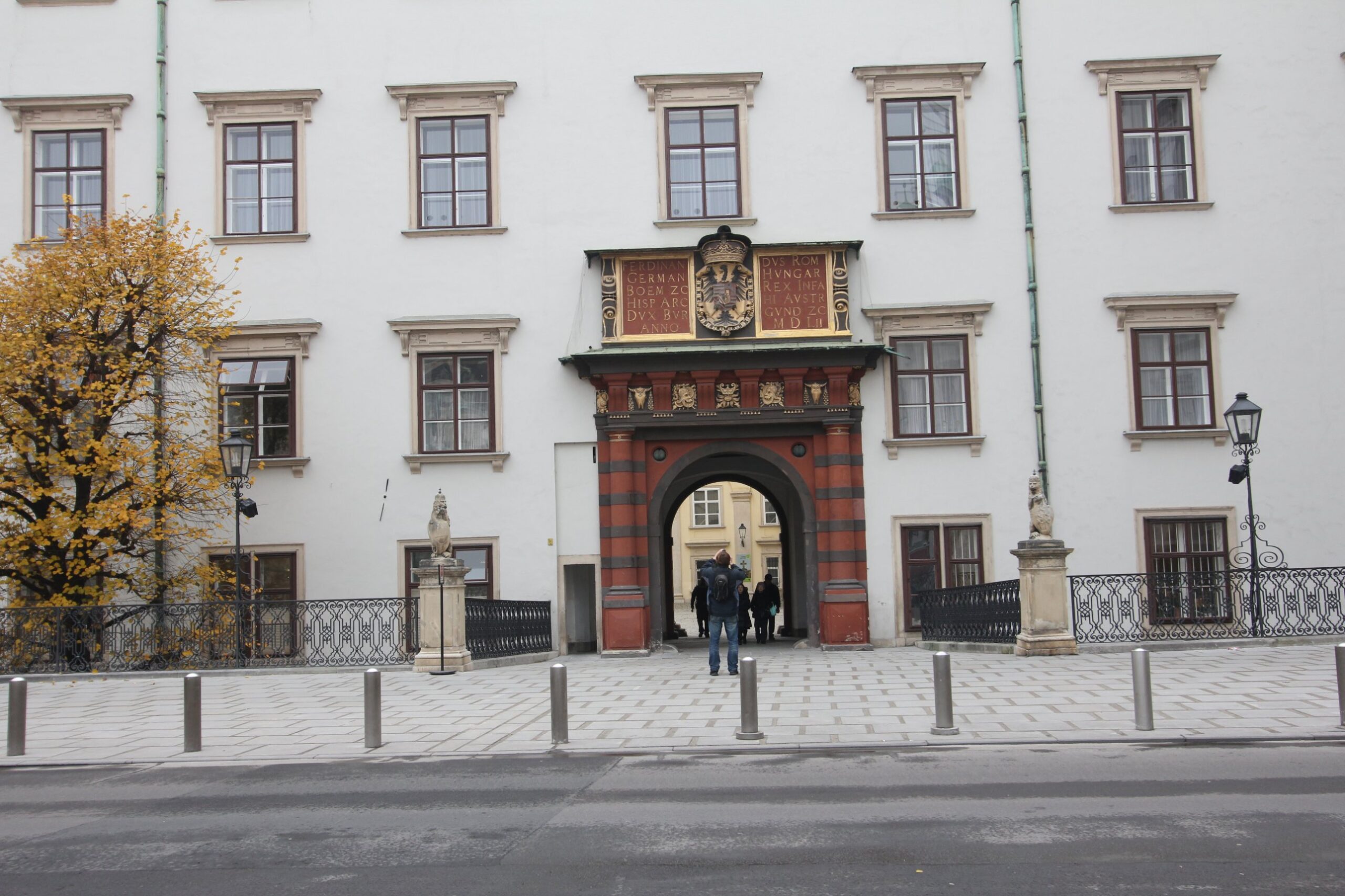
Photo: Virtual Travel Guide
It comes in two halves. The secular treasury holds regalia, jewels and heirlooms. The ecclesiastical treasury holds relics, altars and devotional objects, mostly Baroque. Most visitors rush the second half. That's a mistake if you like goldsmiths' work, but if time is short, it's the half to skip.
The crown that outlived its empire
The Imperial Crown of the Holy Roman Empire is the reason people come. It isn't round. It's eight hinged gold plates set with pearls and uncut stones, four of them with enamel pictures of Old Testament kings and Christ. The arch carries the name of Conrad II. The cross on the front is attributed to Henry II. Most scholars date the crown to the second half of the 10th century; some argue for the 11th.
It wasn't always in Vienna. From 1424 to 1796 it was kept in Nuremberg. It came to Vienna in 1800, ahead of Napoleon's armies, and stayed after the Holy Roman Empire was dissolved in 1806. The Nazis took it back to Nuremberg in 1938. It returned to Vienna in January 1946.
Next to it is the Holy Lance, believed in the Middle Ages to be the spear that pierced Christ's side. The blade is 8th century. A silver sleeve was added for Henry IV in the 11th century and a gold one by Charles IV around 1354, inscribed "the lance and nail of the Lord". A nail said to be from the Cross is set into the blade.
The Austrian crown and the inalienable heirlooms
The other crown is younger and much showier. Jan Vermeyen made it in Prague in 1602 for Rudolf II as his private crown: gold, enamel, diamonds, rubies, spinels, pearls and a large sapphire on top. It became the crown of the Austrian Empire in 1804, when Francis II declared himself Emperor of Austria two years before the old empire ended. The full story of Rudolf's crown.
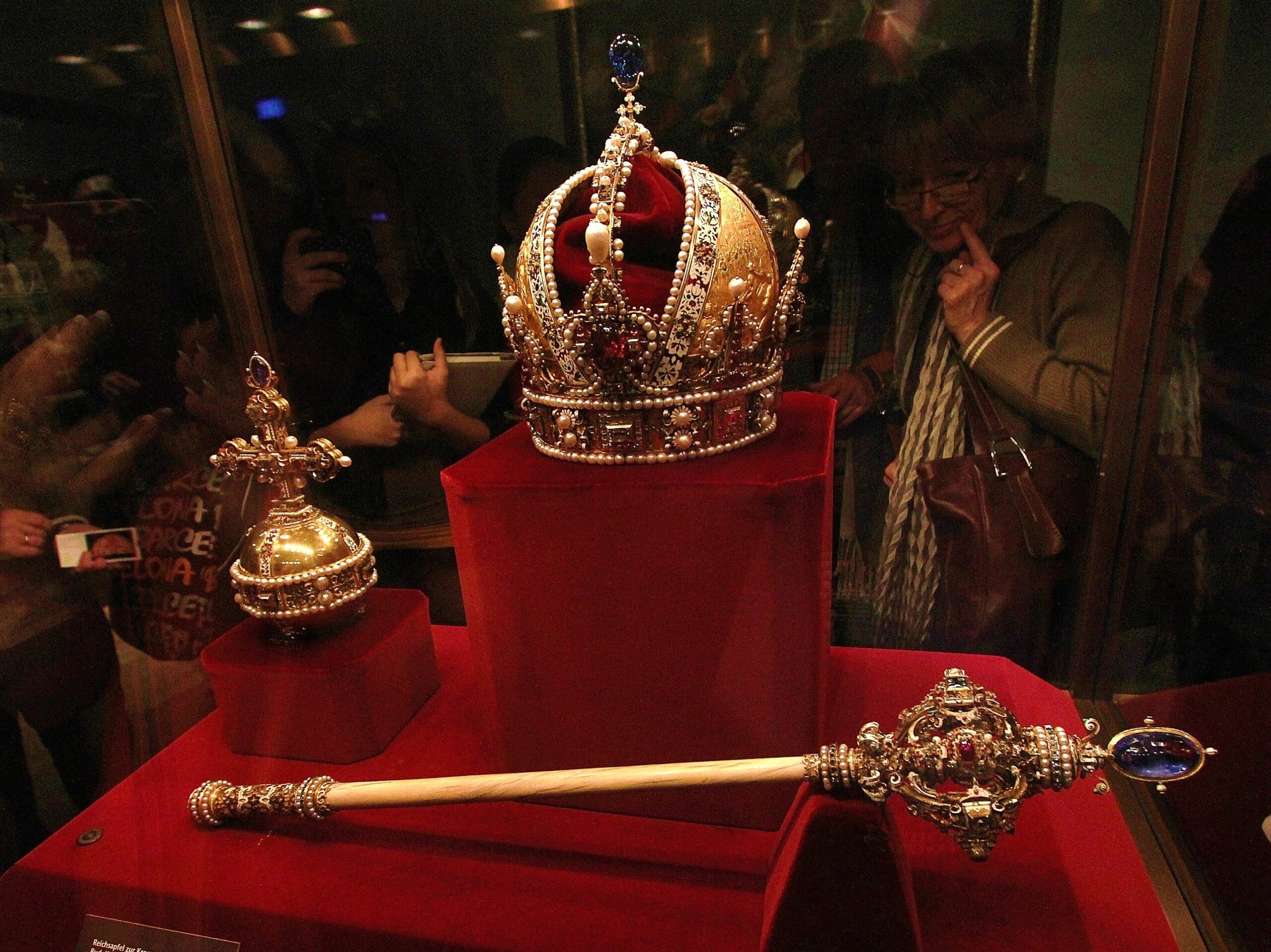
Photo: Virtual Travel Guide
Then there are the two pieces the family swore never to sell. In 1564 the heirs of Ferdinand I declared them "inalienable heirlooms of the House of Austria". One is a narwhal tusk, which the court believed was a unicorn horn. The other is a 4th-century agate bowl, probably from Constantinople, about 58 centimetres across. It's the largest hardstone carving to survive from antiquity, and the veins in the stone seem to spell out XRISTO, which made people think it was the Holy Grail.
Look out too for the silver-gilt cradle the City of Paris gave Napoleon's son, the King of Rome, in 1811, and the treasure of the Burgundian dukes and the Order of the Golden Fleece, which came to the Habsburgs when Maximilian I married Mary of Burgundy in 1477.
More in the cases
Give the smaller rooms time. The labels are in German and English, and some of the best pieces are easy to walk past.
The Order of the Golden Fleece came to the Habsburgs with the Burgundian inheritance. Its herald wore this potence, a collar of gold and enamel plaques painted with coats of arms. The label gives the Netherlands, probably 1517. More on the herald's chain.
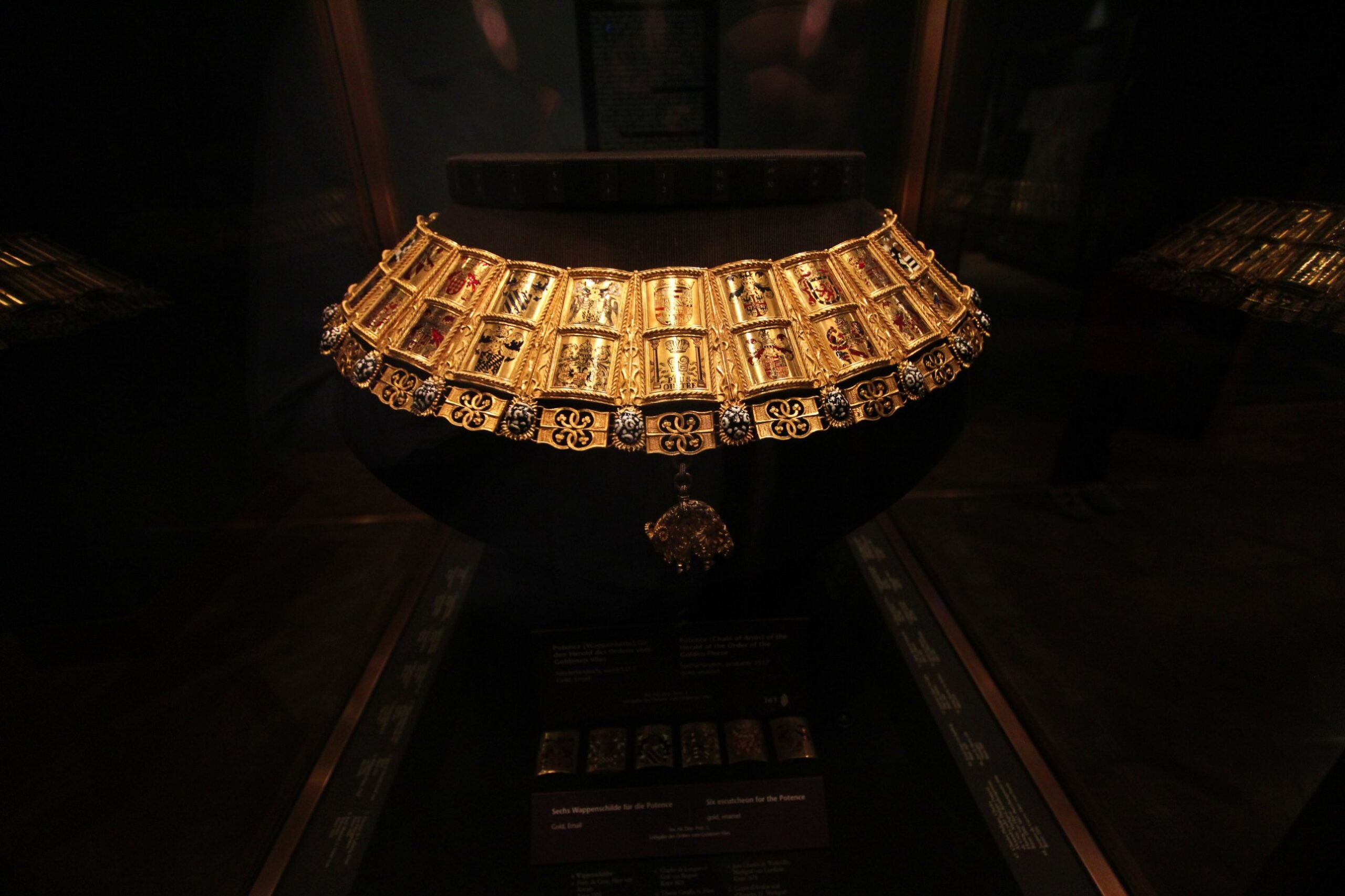
Photo: Virtual Travel Guide
In the baptism room are the gold ewer and basin a Spanish master made in 1571 for imperial christenings. Beside them stands a small ewer by Jan Vermeyen, the goldsmith of Rudolf II's crown, made in Prague between 1600 and 1605. More on the baptism set.
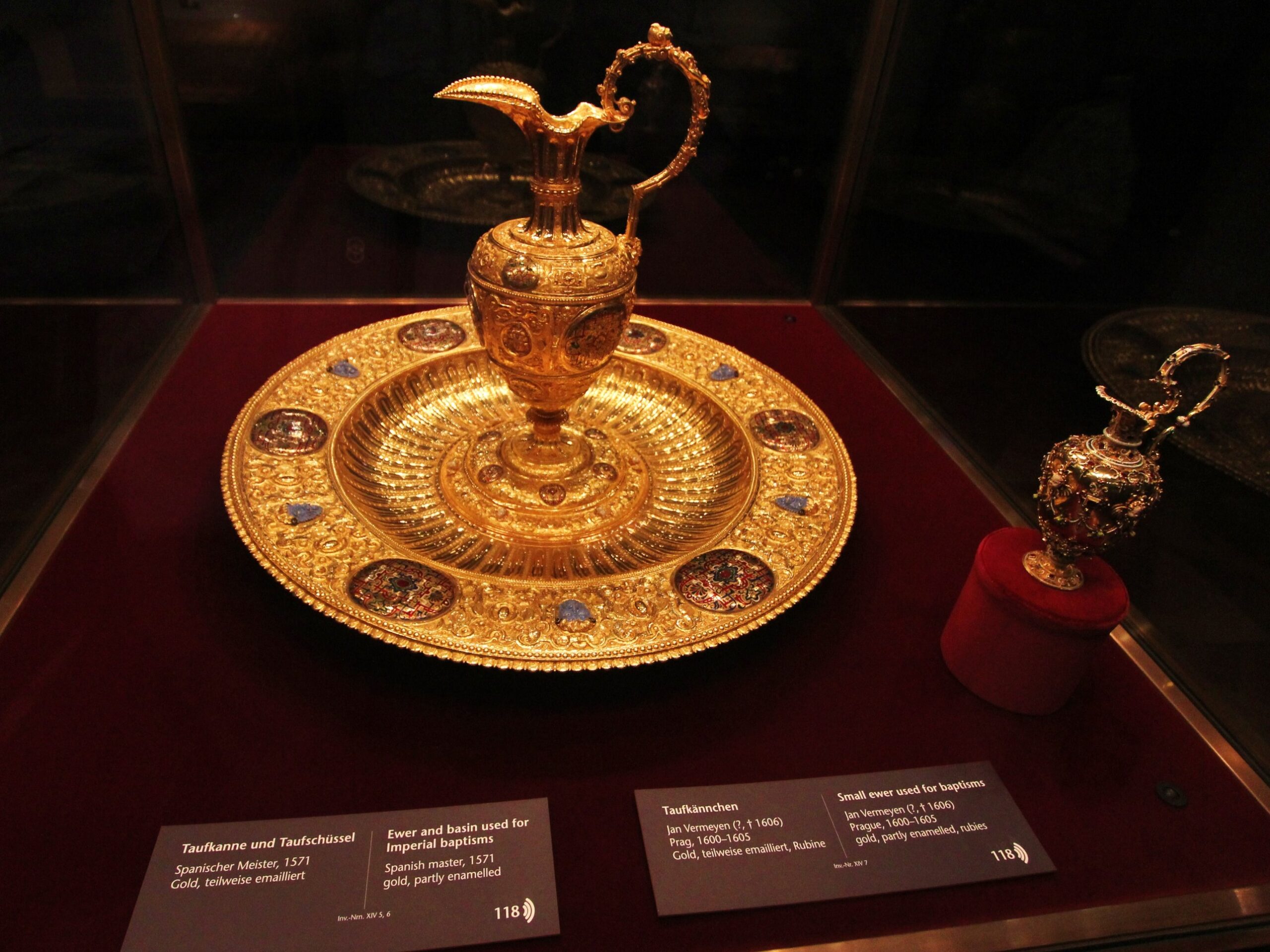
Photo: Virtual Travel Guide
One case belongs to Maximilian, Franz Joseph's younger brother, who became Emperor of Mexico in 1864 and was executed there in 1867. It holds the chains of two Mexican orders, sceptres from 1863 and his tortoiseshell walking cane. More on the Mexico case.
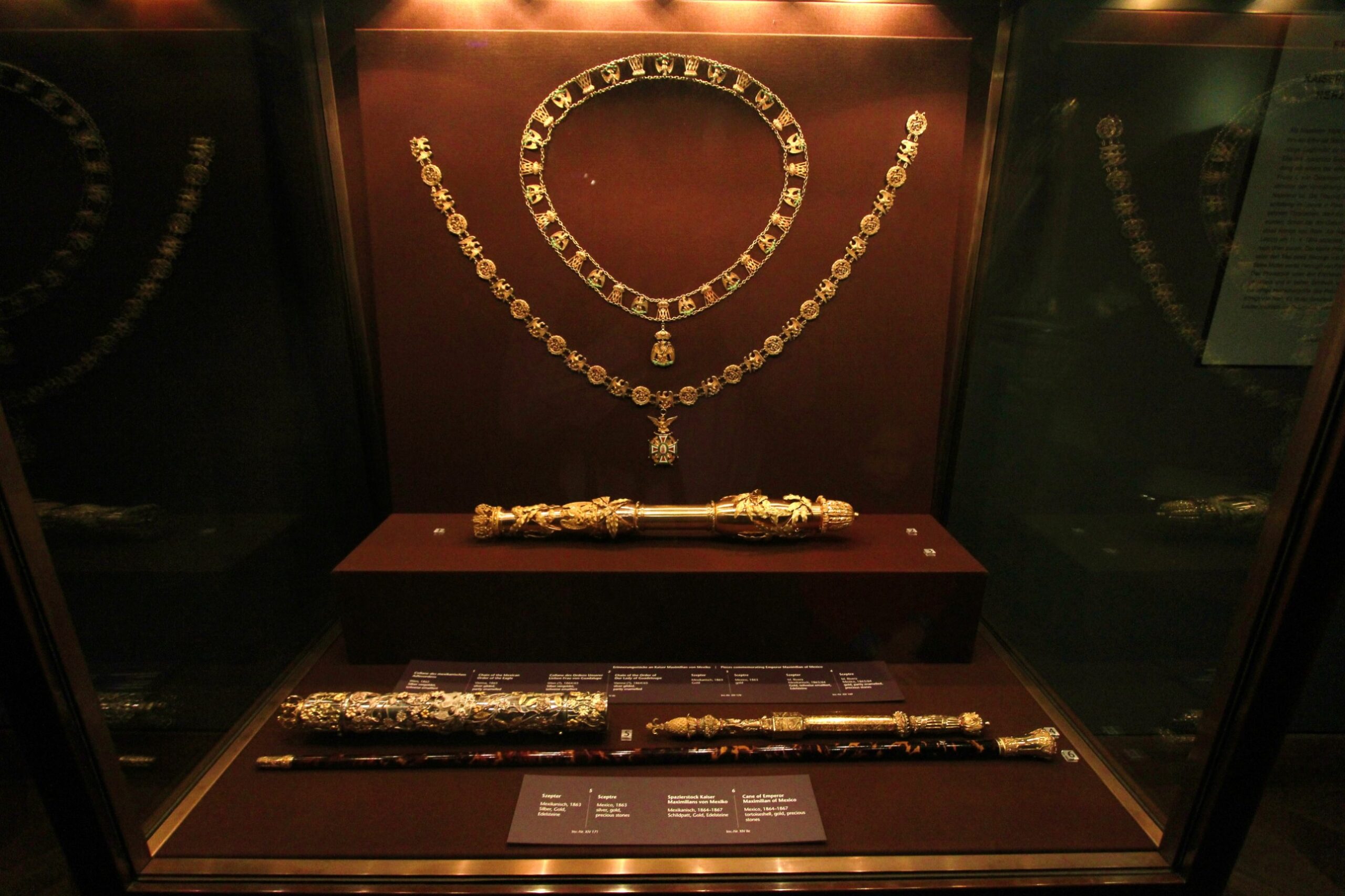
Photo: Virtual Travel Guide
The jewels room has one of the largest emeralds in the world, carved and hollowed into a small vessel. The story of the emerald vessel.
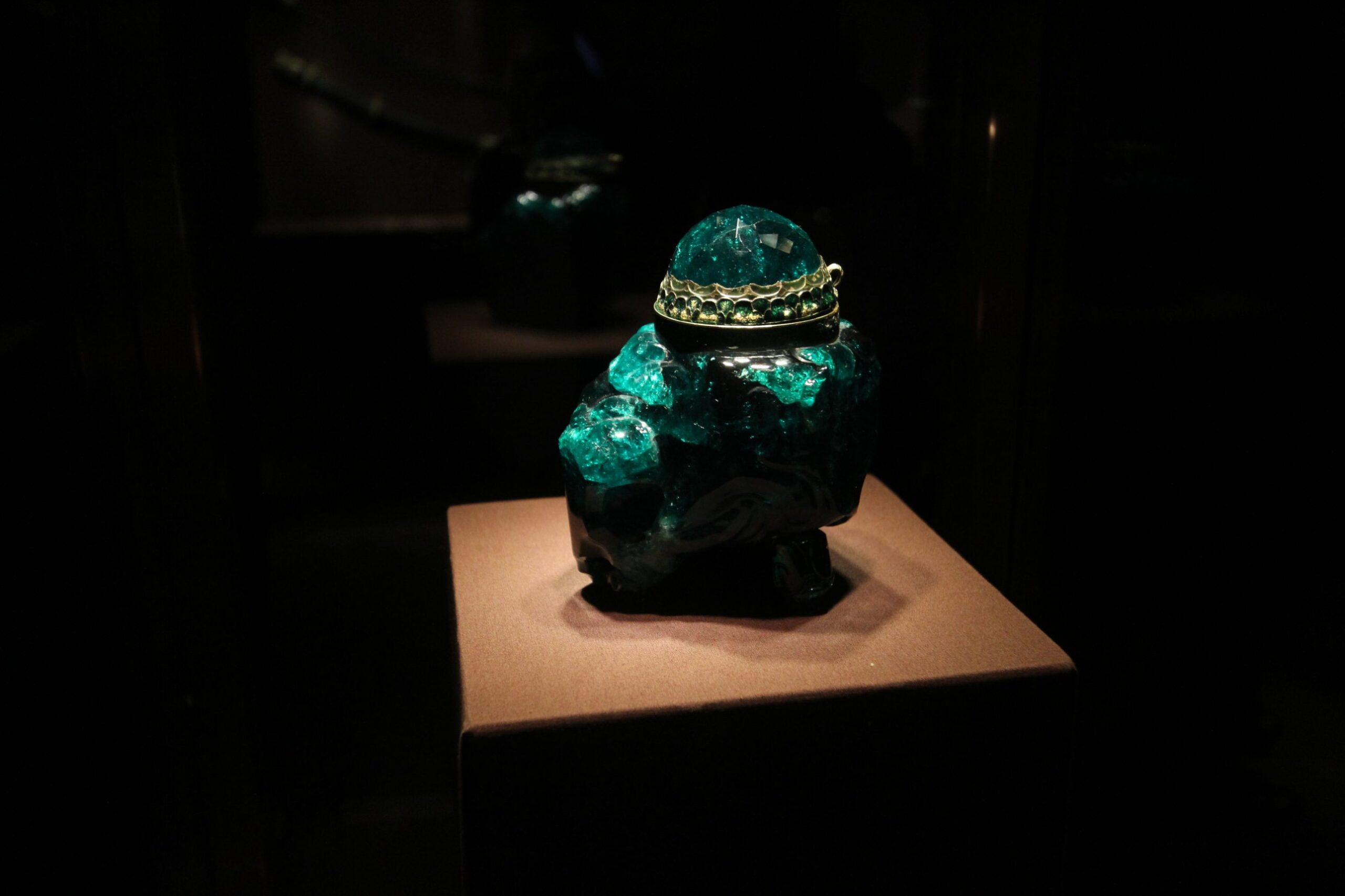
Photo: Virtual Travel Guide
And some pieces exist purely for show, like these two bouquets of flowers in gold, enamel and precious stones, probably made in Florence between 1680 and 1700 and lent from the Kunsthistorisches Museum's Kunstkammer. More on the bouquets.
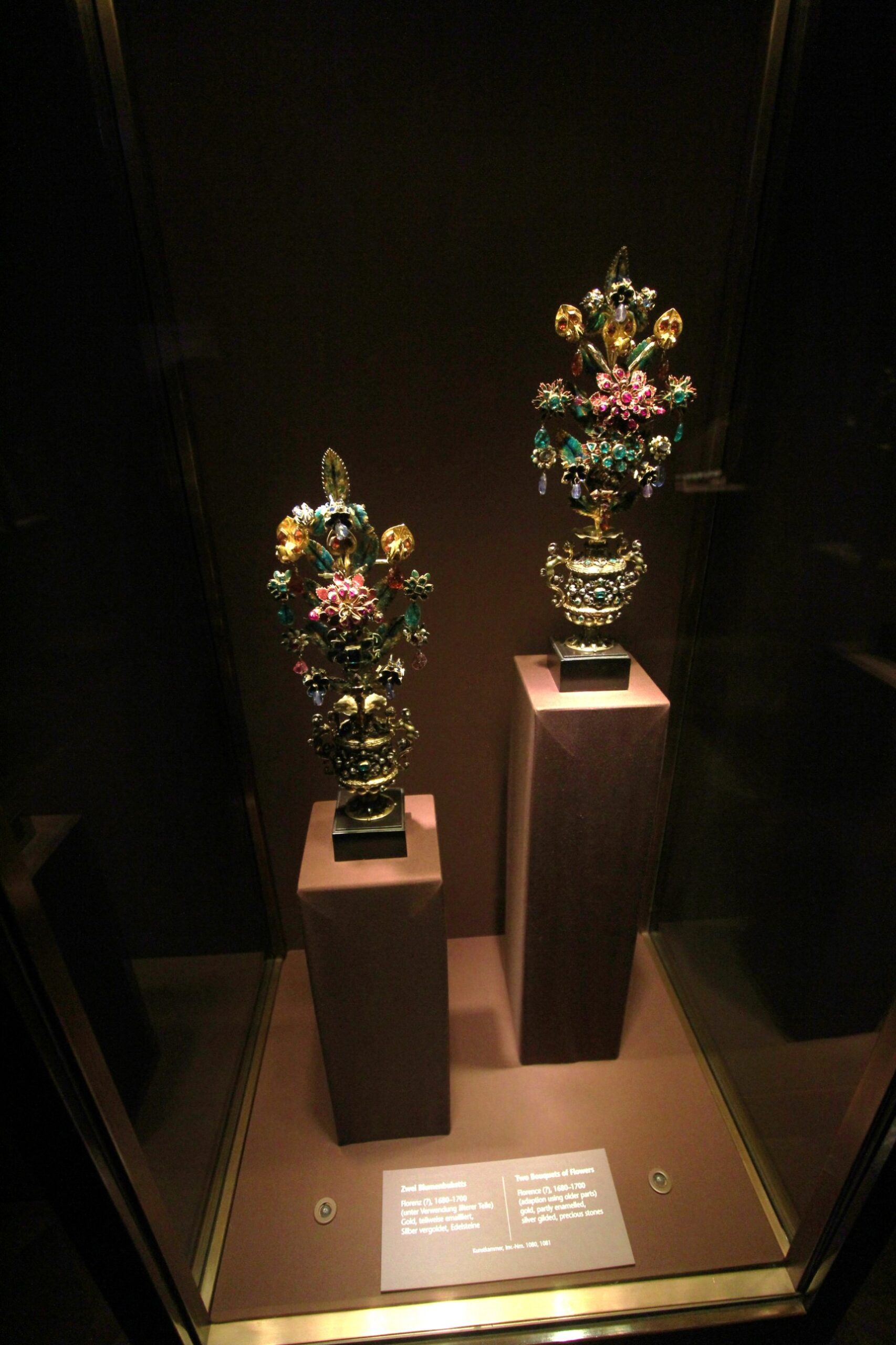
Photo: Virtual Travel Guide
Tickets and hours, as of October 2026
- Open Wednesday to Monday, 9:00 to 17:30. Closed on Tuesdays.
- Since 1 April 2026, entry is by booked time slot.
- Adults €16 online, €18 at the desk. Reduced €12 online, €14 at the desk.
- Under 19 free.
The "Treasures of the Habsburgs" ticket adds the Kunsthistorisches Museum across the Ring for €32 and is valid for a year. If you're going to the KHM anyway, it's the obvious buy. The Treasury isn't part of any Sisi Museum ticket, which is run by a different operator.
The entrance is step-free. The rooms are up about twenty steps, with a lift.
Allow an hour and a half. The crown room gets crowded around midday; first thing in the morning is calmer.
Across the Ring, the KHM's own Habsburg collections pick up where the Treasury leaves off: Kunsthistorisches Museum Vienna, the Kunstkammer, the Stolen Saliera and 12 Bruegels on Travel Magazine.