Imperial Crown of Austria, the Private Crown Rudolf II Had Made in Prague in 1602
Most crowns are made for a coronation. This one never saw one. Rudolf II had it made in Prague in 1602 to wear when the real imperial crown was out of reach, and two centuries later it became the crown of an empire that didn't exist when it was made.
It sits in the Imperial Treasury in the Schweizerhof, in a case with the orb and sceptre made to match it a few years later. Together they're the set most people mean when they say "the Habsburg crown jewels".
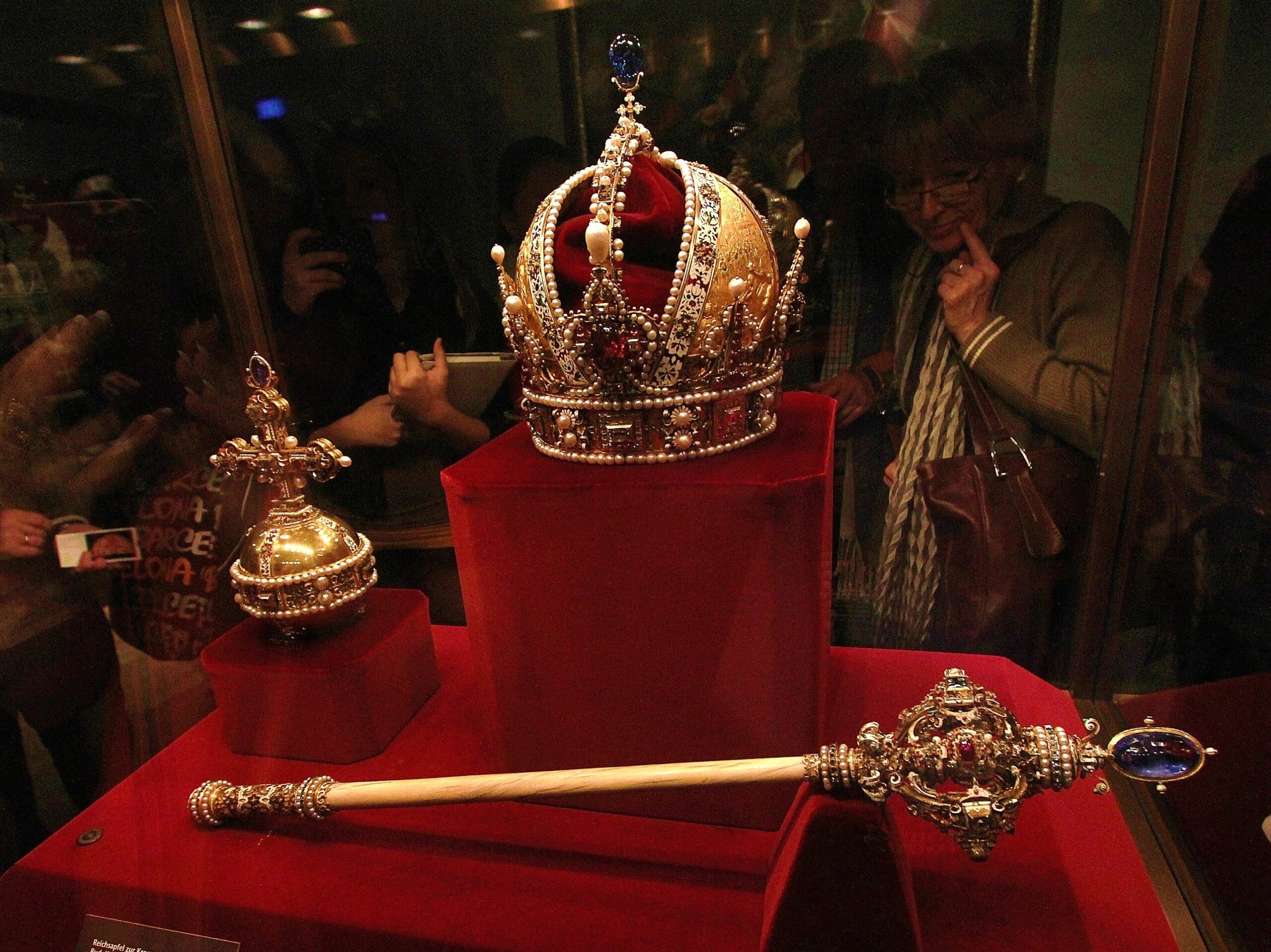
Photo: Virtual Travel Guide
Why an emperor needed a second crown
The crown of the Holy Roman Empire, the one now in the same Treasury, was kept in Nuremberg in Rudolf's day and only came out for coronations. For every other state occasion an emperor needed his own. These private crowns were usually broken up when their owner died, and the stones reused.
Rudolf's wasn't. He brought Jan Vermeyen, a goldsmith from Antwerp, to his court in Prague to make it, and the inscription inside the arch records the date: RVDOLPHVS II, Roman Emperor, King of Hungary and Bohemia, built it, MDCII. It is 28.3 centimetres high, in gold, enamel, diamonds, rubies, spinels, pearls and a sapphire, over a red velvet cap.
Three crowns in one
Vermeyen built it from three parts, and each one means something.
The circlet, with its lily-shaped points, is a royal crown. It stands for Rudolf's two kingdoms, Hungary and Bohemia. Eight diamonds are set into it, eight because the old imperial crown has eight plates.
The mitre, the gold dome inside the circlet, comes from a bishop's mitre turned sideways. It says the emperor rules by the grace of God and holds a spiritual rank as well as a worldly one. Its four enamelled scenes show Rudolf as he wanted to be seen: kneeling to receive the imperial crown in Regensburg, riding up the coronation hill at Pressburg as King of Hungary, in the coronation procession through Prague as King of Bohemia, and in an allegory of victory over the Turks. That last one was a hope more than a record.
The arch, running from front to back over the top, copies the arch of the Holy Roman crown. A large blue sapphire sits at its peak, above a small cross.
Rows of pearls run along every edge and hold the three parts together visually. The enamel work is typical of Rudolf's court in Prague, which drew the best goldsmiths and stone-cutters in Europe.
The orb and sceptre
Rudolf died in 1612. His brother Matthias, who succeeded him, had a matching orb and sceptre made by Andreas Osenbruck, who became his court goldsmith that year.
The sceptre is signed and dated 1615 and carries Matthias's name and the year 1612. Its shaft is a narwhal tusk, which the court believed was unicorn horn, a material linked to Christ and the Virgin and so fit for a ruler. An iron bar runs inside it to stop the heavy jewelled head from bending it. It is 75.5 centimetres long and weighs 1,640 grams.
The orb, made between 1612 and 1615, follows the crown: a band of diamonds and paired pearls round the middle, enamelled bands of fruit and animals dividing the globe, and an old, uncut sapphire on the top, probably reused on purpose to suggest continuity of power.
From house crown to state crown
On 11 August 1804, with Napoleon about to crown himself in Paris, Francis II proclaimed the Austrian Empire and took the title Francis I of Austria. He needed a crown for it, and Rudolf's was the obvious choice. It stayed the crown of the Austrian Empire until 1918.
It was still never used to crown anyone.
The Treasury is open Wednesday to Monday, closed on Tuesdays, with timed tickets since April 2026. For prices, hours and the rest of the collection, see our Treasury guide.