Imperial Baptism Ewer and Basin of 1571, Ten Kilos of Gold From a Habsburg Wedding
For about three hundred years, when a Habsburg baby was christened, the water came out of this ewer and fell into this basin. Together they weigh about ten and a half kilos of gold. They weren't made for baptisms at all.
They stand in the Imperial Treasury in the section on ceremony at the imperial court: a tall gold ewer, 34.5 centimetres high and 3,350 grams, on a basin 61.5 centimetres across that weighs 7,220 grams. The label calls the maker a Spanish master and gives the date as 1571.
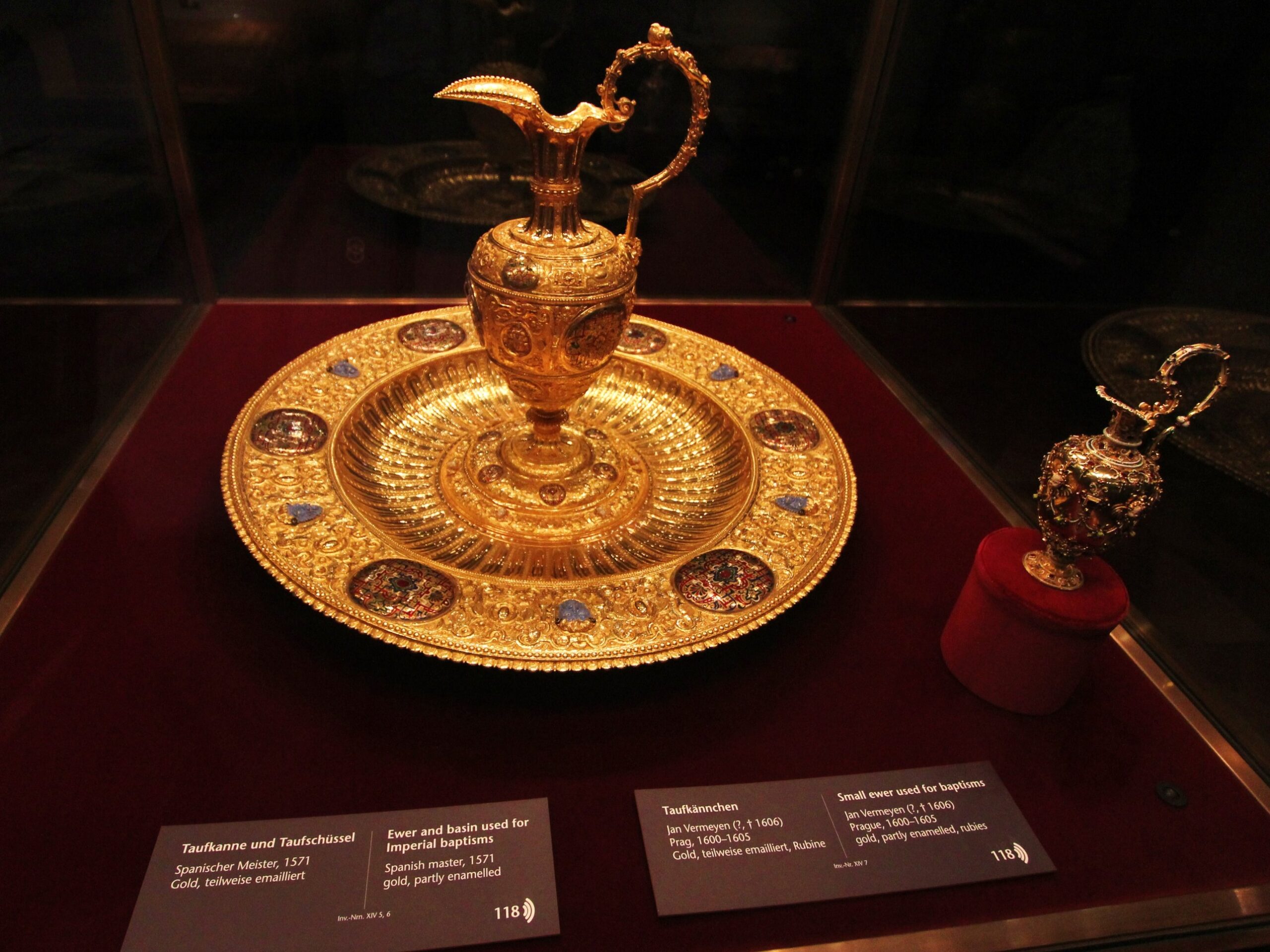
Photo: Virtual Travel Guide
A wedding present from Carinthia
In 1571 Archduke Charles II, who ruled Inner Austria from Graz, married Maria of Bavaria. The estates of Carinthia, one of his provinces, gave the couple this set as a wedding present, with 10,000 guilders on top. Georg Khevenhüller, head of the provincial government, handed it over in Graz on 11 September 1571. The Carinthian arms are on the body of the ewer and in the centre of the basin.
It was made as a lavabo, a ewer and basin for washing hands at table. There are no religious images on it. The gold is beaten and partly enamelled. Gold wasn't hallmarked then, so nobody can say for sure where it was made. The style points to a Spanish goldsmith, and the museum leaves the place open as Spain or Vienna. If it was Spain, the gold most likely came from the Americas.
From hand-washing to christenings
The set passed from Maria of Bavaria to her son, who became Emperor Ferdinand II. He brought it to Vienna and put it in the treasury.
At some point it became the family's christening set, and the Habsburgs used it, or at least the basin, for baptisms until the end of the monarchy.
Court christenings were state ceremonies, held within hours of a birth or the next day at the latest, in a room of whichever residence the child was born in. The baby was carried in on a cushion under an embroidered coverlet and changed into a light christening gown for the rite. Maria Theresa had a matching set of coverlets, cushion and gown made in 1757, in silver cloth with gold and pearl embroidery and her initials in pearls. It's in the Treasury too.
The little ewer beside it
Next to the big set stands a much smaller gold ewer, 15.5 centimetres high, with rubies. The museum attributes it to Jan Vermeyen and his workshop in Prague, 1601 to 1605: the same goldsmith who made Rudolf II's crown, now the Imperial Crown of Austria, and the goldwork is closely related. The Habsburg arms sit under the top of the handle.
The museum's reading is practical. The 1571 ewer was simply too big and heavy to hold over a newborn, so a smaller one was made. It carries no national emblem, which suggests it was ordered for an archduke rather than the emperor, possibly the future Ferdinand II, who married Maria Anna of Bavaria in 1600.
Seeing it
The baptism pieces are in the Secular Treasury, among the objects on court ceremony. See our Treasury guide for prices and the rest of the rooms.