Archduke Charles Monument on Heldenplatz, the Bronze Horse That Stands on Two Legs
The horse is the reason everyone stops. It rears up so far that only its two hind hooves touch the pedestal, and nothing else holds it. When Anton Dominik Fernkorn unveiled it on Heldenplatz on 22 May 1860, it was hailed as the first monumental bronze statue anywhere supported at just two points.
On its back is Archduke Charles of Austria, holding a flag high and turning to lead his men forward. The scene is the Battle of Aspern, 21 and 22 May 1809, the first major defeat of Napoleon's career in the field. The statue was unveiled on the battle's anniversary.
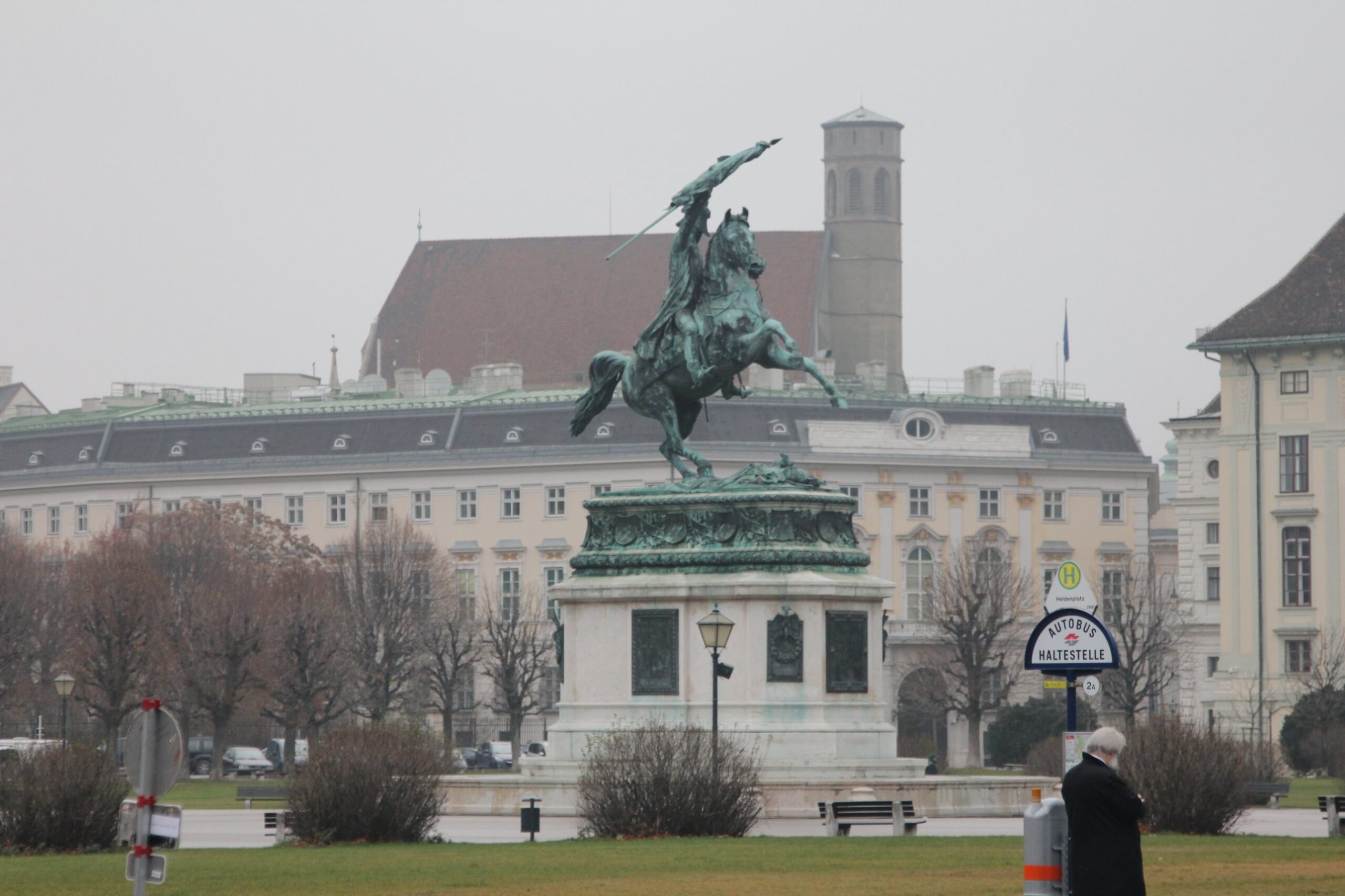
Photo: Virtual Travel Guide
The general
Charles was born in Florence in 1771, a son of the future Emperor Leopold II, and became one of Austria's ablest commanders of the Napoleonic wars. He beat Jourdan's French armies at Würzburg in 1796 and at Ostrach and Stockach in 1799. In 1806 he was made Generalissimus and set about reforming the army. At Aspern, across the Danube from Vienna, he stopped Napoleon. Six weeks later he lost at Wagram, and the war with it.
He married Henriette of Nassau-Weilburg in 1815, died in Vienna in 1847 and lies in the Imperial Crypt.
The sculptor and the statue
Fernkorn was a German metalworker and bronze caster from Erfurt, trained in the royal foundry in Munich rather than at an academy of art. He came to Vienna around 1840 and designed the statue as early as 1847; the Wien Museum still has his bronzed plaster model from that year, 66 centimetres high. He modelled the full-size figure and cast it himself, in the 1850s. The pedestal was designed by Eduard van der Nüll, one of the two architects of the Vienna State Opera.
The pose has a source. Fernkorn took the flag-in-hand moment from Johann Peter Krafft's painting of the battle.
The dedication was planned for 1859, the 50th anniversary of Aspern. It was put off after the Austrian defeats at Magenta and Solferino that summer, and held a year later. Franz Joseph gave Fernkorn the Order of Leopold, and in 1860 the sculptor was raised to the hereditary nobility.
What the pedestal says
The front, facing the Volksgarten, names the donor: Emperor Franz Joseph I to Archduke Charles of Austria. The two side inscriptions are the ones people quote:
"Dem heldenmüthigen Führer der Heere Oesterreichs", to the heroic leader of Austria's armies.
"Dem beharrlichen Kämpfer für Deutschlands Ehre", to the steadfast fighter for Germany's honour.
That second line makes sense only in 1860. Austria still led the German Confederation then, and the monument was a claim to that role. Six years later Austria lost the war with Prussia and was pushed out of German affairs for good. Twelve shields round the pedestal list Charles's victories, from Aldenhoven in 1793 to 1809.
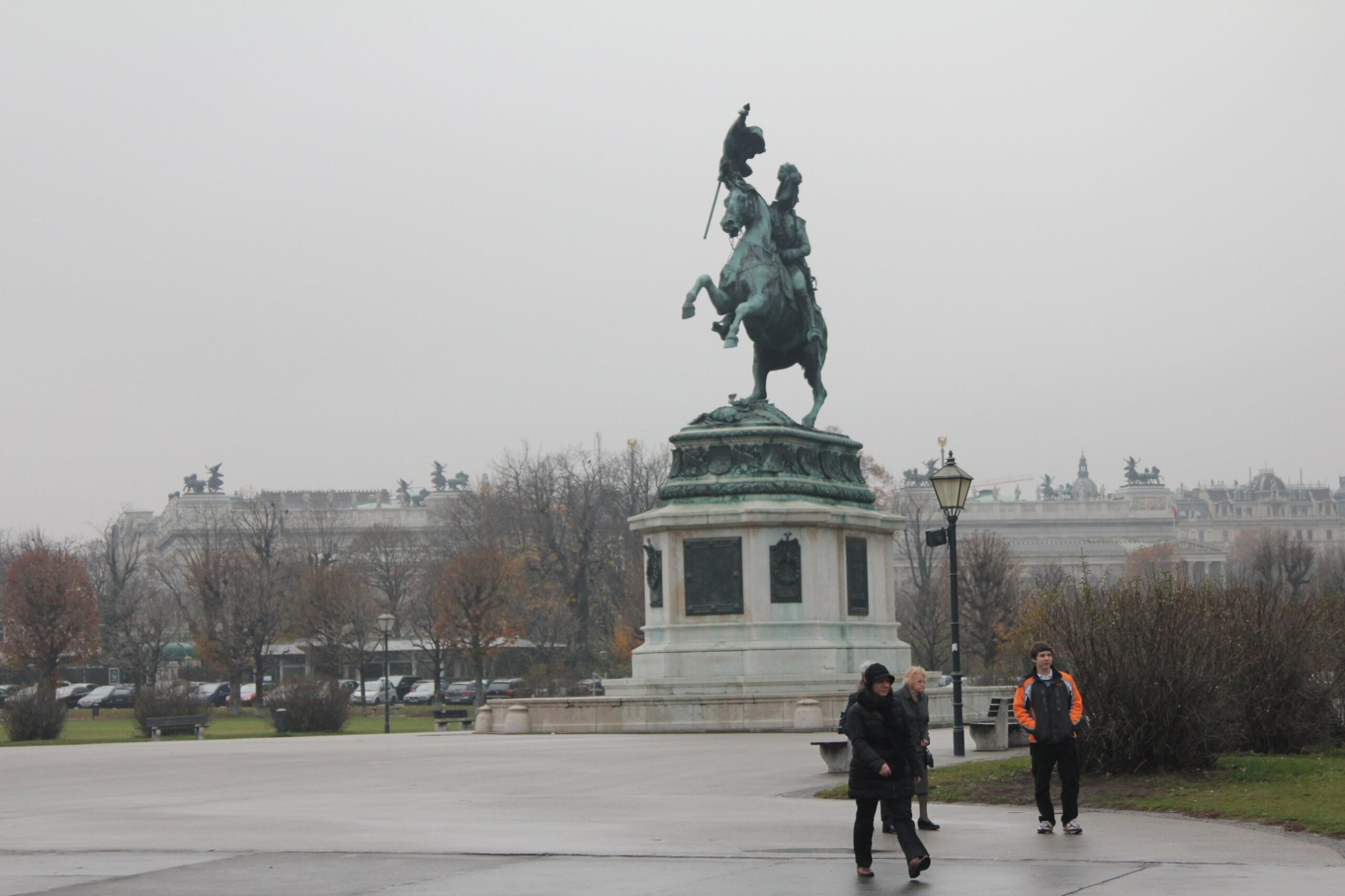
Photo: Virtual Travel Guide
Seeing it
It stands on the Volksgarten side of Heldenplatz, facing its partner across the square, Prince Eugene, by the same sculptor. Walk round it. From the side you see how little holds the horse up, and from the back, the long tail that, unlike Eugene's, doesn't touch the ground.
A smaller replica stands in the park of Schloss Weilburg near Baden.
For the square and its history, see our Heldenplatz guide.