Historic Cafés Near the Hofburg, From the Imperial Confectioner Demel to the Palm House
The court is gone, but the places that fed it are still open. Within ten minutes' walk of the Hofburg are a confectioner that held the imperial warrant, a hotel café built on the site of a court theatre, and a palm house the emperor used for his own leisure. You can sit in most of them for the price of a coffee and a slice of cake.
A word on manners first. A Viennese coffee house expects you to stay. Order, and nobody will rush you; a glass of water comes with the coffee. What it doesn't expect is a queue, which is why the famous ones have them and the good ones often don't.
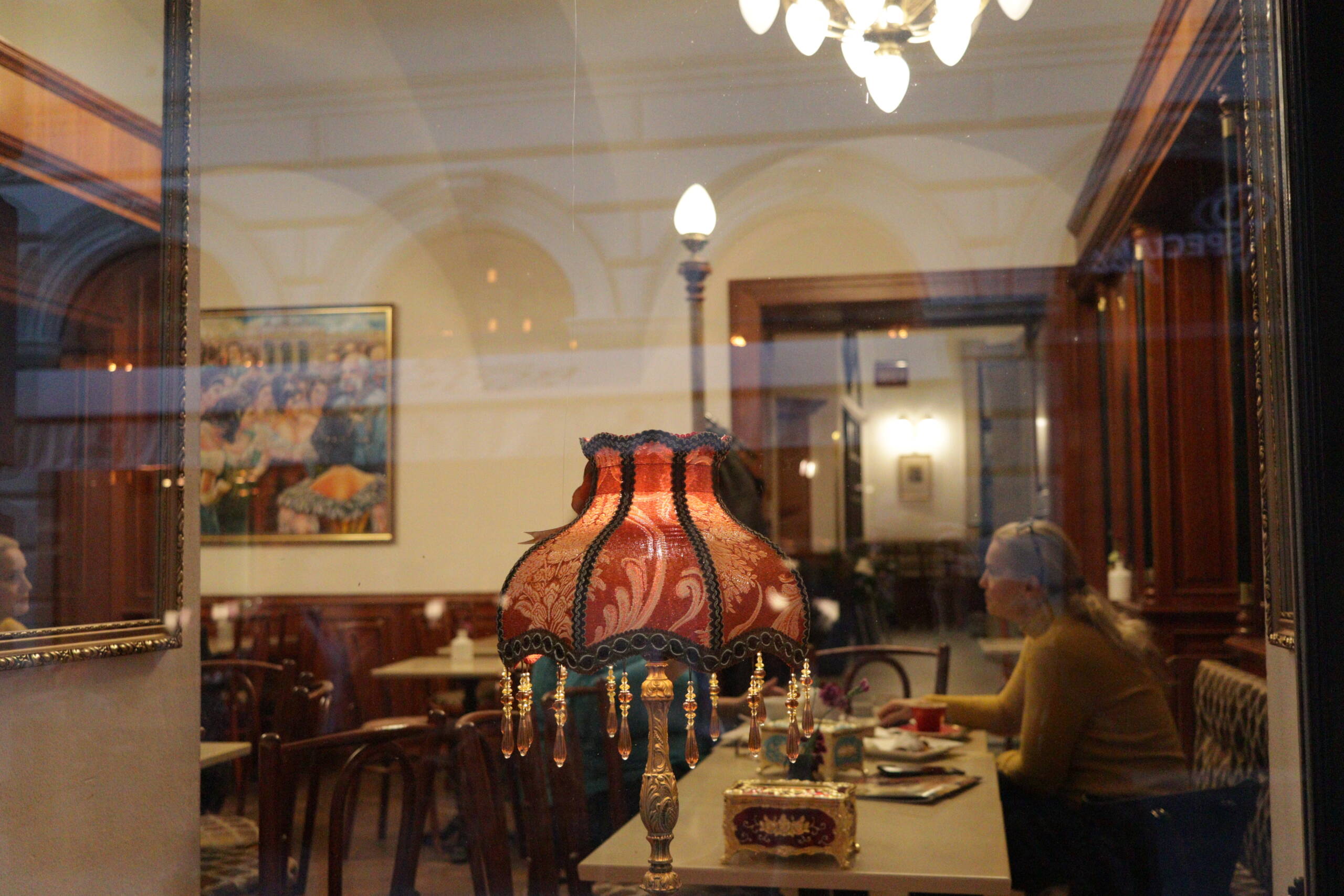
The picture below is the kind of room you're looking for: a chandelier, panelled walls, newspapers, and someone who's clearly been there a while.
Demel, Kohlmarkt 14
The one with the strongest tie to the palace. Ludwig Dehne, a confectioner from Württemberg, opened it in 1786 on Michaelerplatz, right in front of the Hofburg. Christoph Demel bought it in 1857 and the family name stuck. From 1874 it supplied the imperial court, and it still signs itself k.u.k. Hofzuckerbäcker, imperial and royal court confectioner.
It moved to Kohlmarkt after the old Burgtheater on Michaelerplatz was pulled down in 1888, which is why it now sits halfway up the street that leads to the Michaelertor. Open daily from 10:00.
Café Sacher, Philharmonikerstraße 4
The Sachertorte goes back to 1832, when Franz Sacher, then 16 and working in Prince Metternich's household, created it. His son Eduard, also a court purveyor, opened the Hotel Sacher in 1876 on the site of the old Kärntnertor Theatre, behind the opera. Under Eduard's widow Anna Sacher it became the place where aristocrats and diplomats met.
The café is the most famous queue in Vienna. Go early or late. Open daily 7:00 to 23:00.
Café Mozart, Albertinaplatz 2
At the southern tip of the Hofburg, opposite the Albertina. Georg Pöhlein founded it in 1794; it went through other names before Oskar Hornik renamed it after Mozart in 1929. The Hornik family was forced to sell in 1938 and later got it back. After the war it was part of the black-market Vienna of Graham Greene's The Third Man, and Anton Karas, who played the film's zither theme, wrote a "Café Mozart Waltz". Open daily from 8:00.
Palmenhaus, Burggarten 1
The only café actually built into the palace grounds. The Palm House at the back of the Burggarten, set against a wing of the Hofburg, is an Art Nouveau iron-and-glass greenhouse built in the early 1900s by the court architect Friedrich Ohmann, replacing an older greenhouse from the 1820s. It closed in 1988 and reopened in 1998 after restoration.
Today the centre is a brasserie, the left wing is the Butterfly House, and the right wing is still a working greenhouse of the federal gardens. In summer, the terrace looks over the Burggarten lawns where the Mozart monument stands.
Café Central, for later
Café Central in Palais Ferstel on Herrengasse, two minutes from Michaelerplatz, opened in 1876 and turned 150 this year. It closed on 16 March 2026 for a full renovation. The owners say it reopens in winter 2026; until then a pop-up called Decentral runs at Freyung 3. Check before you go.
Café Landtmann on the Ring, opened in 1873, is the other grand one within reach, by the Burgtheater and the university.
For the palace itself, start with our guide to the Hofburg's wings and history. For how to order and how long you can stay, see Vienna Coffee Houses, How to Order and How Long You Can Stay on Travel Magazine.